 Platoon Manager
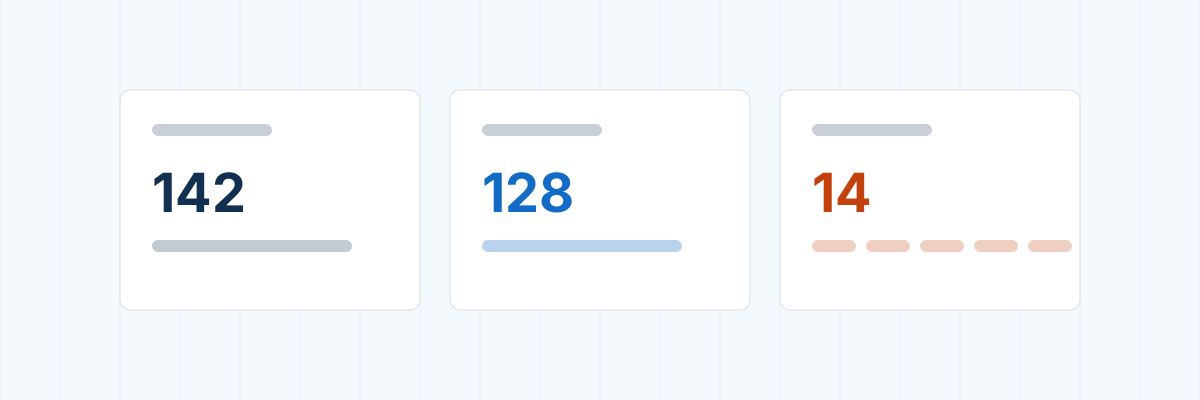
A personnel status report is arithmetic until somebody asks why the assigned number moved. Then it is a records problem.
Assigned, present, and the gap between them
Every report is built on three quantities: who belongs to the unit, who is physically here, and where the difference went. The first two are counts. The third is a list of reasons, and that is where reports come back.
If your roster tracks presence but not reasons with dates, you will produce the first two numbers quickly and then spend twenty minutes reconstructing the third from memory and group chats.
Reasons have to be consistent, not creative
Leave, pass, TDY, school, appointment, and a short free-text reason for the odd case. Six categories cover almost everything, and a fixed list means two platoons reporting the same situation produce the same word.
Free text everywhere feels flexible and produces a report that cannot be totalled. Somebody ends up reading every line to count how many people are at school.
The report should fall out of the roster
If the roster is current at 0700, the status report is a view of it, not a separate document. Any workflow where someone retypes the roster into a second format introduces a third version of the truth and a new place to be wrong.
Reconcile before you submit, not after
The expensive version of this job is submitting a number, having it questioned, and then rebuilding the morning from memory. The cheap version is catching the discrepancy while the platoon sergeants are still standing there.
A useful check before sending: does every person in the gap have a reason with a date attached, and does every date still cover today? Anyone failing either test is somebody whose status is guessed rather than known, and that is exactly the line that comes back.
Who reads it and what they do with it
Above company level, the report feeds decisions about what the unit can be tasked with. A number that is quietly wrong by four does not stay a paperwork problem. It becomes a tasking the company cannot fill, and the correction costs more attention than the original error would have.
That is the argument for accuracy over speed when the two conflict. A report sent ten minutes late with a correct gap is worth more than one sent on time that has to be amended.
Keep the ones you sent
When a number is questioned three weeks later, the useful answer is the report as it was submitted, not a rebuild from today's roster. Storing sent reports also shows trends nobody notices day to day, like a squad whose strength has quietly dropped by four since the last cycle.
Related
Produce the report from the roster you already keep
Platoon Manager builds the report out of the same roster the formation used that morning, with the reason and the date range already attached, and keeps every report you have sent. Run one for your company and see whether the numbers match what you would have typed.